Archive for the ‘Bob’s Blog’ Category

Simple Fuel Pressure Gauge for Peak Fuel Pressure Reading

Monday, March 19th, 2012

We used a simple fuel pressure gauge with a peak hold needle to record our highest fuel pressure value from a run.  The gauge is an all stainless, bottom 1/4NPT pipe, glycerin filled gauge with a maximum indicating needle. Glycerin filling is needed to dampen the needles from racer vibrations.  Stainless is needed for resistance to the corrosive alcohol & nitro that we were running.  The face was standard with lexan or composite.  A glass face should be avoided due to cracking susceptibility.  Either a rear fitting or a bottom fitting are available.  

Installation on Blown Alcohol/Nitro Racing Engine
It was installed on the fuel injection distribution block after the metering valve.  The gauge worked very well recording our fuel pressure values of 130 to 150 psi.   This pressure location is after the barrel valve.  As a result, part throttle fuel pressure spikes that occur before the barrel valve are ignored.

Gauge Manufacturers
Our most recent fuel pressure gauge purchase was a Noshok 25-510-300-MIP. It was purchased from a local Noshok distributor. The Noshok corporate phone number is (440) 243-0888 to find a local distributor. Other gauge manufacturers are:
1. McMaster-Carr model 3842K717.  We am not sure that P/N has all the features.  Phone number; (330) 342-6100
2. Wika, Lawrenceville, GA (770) 513-8200 http://www.wika.com
3. Chicago Stainless 2N-6-1/4NPT-GF-BT.  Again we am not sure that P/N has all the features.  Phone number: (800) 927-8575
4. Reptech, Cato Western, Inc. (800) 822-0804
5. Branum
6. Rototherm.

Fuel Pressure Peak Recording Needle
The extra needle to store the peak value after a run is called different names from the different manufacturers: maximum indicating needle, maximum pressure register, tattle-tale indicator or needle, drag follower or pointer.

Gauge Scale
The gauge scale can be specified from any of these suppliers.  A 0-300 scale was chosen for our FI application.  That scale puts our 150 psi target reading in the middle of the scale, that is the most accurate and repeatable reading range of the gauge.

Cost & Delivery
Around $100 to $150 USD. They all have to be built from a pre-order, taking 1 to 3 weeks.  No one had them in stock when we ordered our gauge.

Pressure Gauge + Check Valve Alternative
For blower boost monitoring, we installed an Autometer boost measuring kit. It uses a lower cost gauge with a check valve to hold the highest reading.  Circle Seal Controls (951) 270-6200 http://www.circle-seal.com makes the check valve used in this kit.  It is the 2200 series, available in various sizes. The check valve can leak in time.  We always carried a spare for our boost gauge.  We considered switching over to one of the gauges with peak indicator needle for boost reading, but this setup with the check valve worked fine for many years.

Flatlining Fuel Injection for Max Power in Race Engines

Monday, March 19th, 2012

An Advanced Method in fuel injection tuning for certain normally aspirated (NA) engines is to flatline the fuel curve. Flatlining is not always possible, especially in very high flowing cylinder heads or efficient pent roof heads on small displacement engines. However, in race engines with common wedge heads or early model Hemi heads, volumetric efficiency normally falls off quite a bit with engine speed beyond the peak torque RPM. Flatlining is a method for max power fuel control in this case. Flatlining is further explained in JFIBB, p. 38. And in JFISB, p. 31.

Note the following Example:

  • Volumetric efficiency at horsepower peak for wedge & early Hemi — drops from 100% at the torque peak from the previous example; down to 80% at the horsepower peak
  • Air to fuel ratio at horsepower peak — 5.26 to 1 (similar value as before)
  • High speed jet — big increase from 0.049 inches diameter to 0.092 inches dia. for engines with 80% volumetric efficiency at horsepower peak; even a larger size or no jet at all in some fuel systems.
  • Max. fuel pressure @ 8,000 RPM with the larger high speed open — 55 psi.; only a slight rise from the high speed opening point previously determined.

NA Volumetric Efficiency @ Horsepower Peak Explanation
The volumetric efficiency of the engine at the horsepower peak is lower than it is at the torque peak for these engine designs. At the horsepower peak, intake port flow becomes limiting for the high speed engine demand. That reduces the amount of air in an intake pulse as engine speed goes up. However, the number of power pulses per second increase with engine speed. So horsepower is commonly higher for a range of engine speeds above the torque peak. That is the case up to an RPM limit. Above that, there is a significant reduction in power from engine friction & intake port flow limits. That power reduction is more than the increased power pulses per second at the higher RPM. And horsepower falls off. That all assumes the engine valve train, short block, and ignition are capable of high RPM to a horsepower peak value.

NA Volumetric Efficiency Lower @ HP Peak Explanation
In this example, volumetric efficiency at the horsepower peak was 80%. That is a common value for volumetric efficiency at the horsepower peak RPM of a big block and useful to set up flatlining using Pro-Calc.

No High Speed Jet in Some NA Fuel Systems
Flow bench services often find that the high speed bypass flow through a spring loaded poppet or regulator causes a flow restriction that is adequate for flatlining even with no jet installed. So these systems are delivered that way. High speed poppet spring rate and number of shims can significantly affect the flow restriction of this component. For example, the amount of opening may be restricted by a lighter spring with a lot of shims verses a heavier spring with no shims. A limited opening from the shims is more restrictive and fuel flow is reduced by the poppet alone. In this case, flat lining is limited or cannot be achieved. A stronger spring with fewer or no shims may be less restrictive to fuel flow and flat line better.

No High Sped Jet In Flowed NA System vs. Large High Speed Jet In Calculated NA System
Several flowed systems were analyzed that were set up with no high speed jet installed. The restriction in flow through the spring loaded poppet or regulator was equivalent to a larger high speed jet such as 0.092 from the previous example developed from our math section in “Fuel Injection Racing Secrets“, Appendix 3, and in the Pro-Calc calculator. When a high speed jet is put into the calculator in that size with a volumetric efficiency of 80%, good air to fuel ratio numbers are produced in the 5.26 to 1 range in this example. The calculator can be used to assist a flatlining fuel curve. Setting up a normally aspirated FI fuel system starting out with no jet in the high speed is not recommended without first tiptoeing during testing. And Pro-Calc makes it easy to keep numerical control over the flatlining setup.

Maintain Fuel Pressure
Fuel pressure should be at an engine speed just above the torque peak RPM. It should also be at or above 50 psi to maintain engine response. If the fuel pressure drops below 50 psi at the torque peak opening point, the nozzles should be reduced in size to bring the fuel pressure back up over 50 psi at the torque peak opening point. Several fuel injection manufacturers report also that there is no horsepower gain from high speed fuel pressures above 100 psi in most NA fuel injection systems. That is from using the fuel injection parts as they are manufactured today.

Testing For Flatlining An NA High Speed Bypass
With a system that is not flowed, a high speed bypass jet can first be installed according to the values in our jetting books. Over several test runs, it can be slowly increased in size monitoring spark plug color after loading, engine temperature, and engine power throughout the interim.

Vital Main Bypass Maintenance for Torque Peak AFR
The main bypass jet must be adjusted for air density changes during the interim testing as well. This is necessary to keep the same air to fuel ratio at the torque peak. For dramatic changes in air density, the nozzles may need changing to keep the total nozzle & jet area the same. That is necessary:

  • to keep the system pressure the same
  • to keep engine response the same
  • to keep the high speed poppet or regulator opening at the same engine speed.

Adjusting for Air Density Changes During Interim Testing
Pro-Calc makes it easy to determine the main bypass and nozzle changes necessary for that interim testing.

  • When the main bypass is the only adjustment for different air densities, the proper size to control the AFR can be determined. Changes to fuel pressure result from this. Fuel pressures can also be determined from the calculator to make sure they are not too low for poor response or too high for fuel pump damage.
  • If both nozzle & main bypass adjustments are made for different air densities, the proper sizes of both can be determined to control the AFR & maintain the fuel pressure.

The web site www.airdensityonline.com/free-calcs/ can calculate air density values from known temperature, pressure, and humidity forecasts. And for most USA & some Canadian race track locations, www.airdensityonline.com/tracks/ can provide air density forecasts without computation.

Unfortunately changing the nozzles often requires a lot of work & expense of added nozzles. As a result, tuners will more often change only the main bypass jet size.

Consequence Of Changing Only Main Bypass Jet Size For Air Density Changes
When the main bypass jet is the only change for air density corrections, the total system nozzle & jet area will change. For example, for an air density on a hot day that is lower from the previous 100% value, the main bypass jet size needs to be increased.

  • This is to reduce the amount of fuel to the engine to maintain the same air to fuel ratio.
  • The total system nozzle & jet area increases from this change.
  • The fuel pressure drops for the new setup.
  • Engine response may be less because of lower fuel pressure.

There are several variables that occur from changing only the main bypass for different air densities:

  • engine response from air to fuel ratio
  • engine response from fuel pressure
  • high speed bypass opening point.

Which ones are affecting engine performance are often not known. As a result, the tune-up is wandering in the dark.

Determination of New Fuel System Pressure
Unless the high speed poppet or regulator is re-adjusted for different main bypass jet sizes, it will open at a differing engine speed. In this case, the engine speed will be higher. That introduces another variable into the testing interim that makes tuning difficult. Pro-Calc again makes it easy to determine a new fuel pressure value for a differing system nozzle & jet area total. That new value can be determined at the target high speed opening point. The poppet or regulator can be reset to open at a consistent engine speed, 5,600 RPM in the above example.

Fuel Injection Disclaimer
It is not the intent of this newsletter to provide all of the instructions necessary for how to properly set up mechanical fuel injection to avoid damage occurring from tuning or running mechanical fuel injection. It is not the intent of this newsletter to cover any safety information for mechanical fuel injection or for racing. Anyone who works around mechanical fuel injection or racing should seek that safety information from appropriate sources such as manufacturers and racing organizations.

Tax Time

Monday, March 19th, 2012

We did an article for IHRA in 2006 about racing as a business. The full article can be found in our articles section of our website. We did an extension of that article about a racing business and IRS audit info in last year’s Newsletter, 3-2011, on Racing & Taxes in the USA. The next section is a further extension of these previous articles.

Please see the disclaimer at the end of the section.

Rules Review for What Constitutes a Racing Business for Tax Filing
In the past, we were advised of simple rules to reduce audit rating for a racing business:

  1. show a profit at least 2 out of 5 years for a USA schedule C filing
  2. principle or significant source of income
  3. reasonable ratio of income vs. expenses
  4. And a few others.

Rules for What Constitutes a Racing Business in an IRS Audit
We were also advised that there is a greater standard practiced in an IRS audit:

  1. showing positive trend
  2. you materially participate
  3. advertising labor or expenses such as a web page or web site showing intent to expand sales
  4. operate to make a profit with reasonable business expense decisions and cost outcomes
  5. written records
  6. separate bank account with funds not co-mingled with personal funds
  7. balance statement showing money in, money out, and balance to demonstrate no unreported income
  8. have a substance to the business going beyond the racer such as inventory, a dedicated garage or shop, tools, machinery, business assets, unique or significant designs, trademarks, copyrights, and/or patents
  9. And a few others beyond that.

Capital Loss from Selling a Racing Vehicle, Vessel, or Business

We were advised that if you are selling a race car, race boat, or an entire racing operation in the USA, an IRS Schedule D is used to report the sales price. Racing costs are often excessive, beyond the income of the racing business. And often not all costs that added value to the racer are deducted in prior tax return years. For these cases, you can report those on an IRS Form 8949. Then you can show them as a capital loss on your Schedule D in the year of the sale. You are entitled to a limit of <$3,000> for that year. That is the case even if your loss is greater than that. However, you can carry that excess loss forward. You can take <$3,000> per year until the capital loss is all taken.

Capital Loss Example
A race boat operation was sold out for $24,000. The total capital expenditure over the life of the race boat ownership was $80,000. The business nature of the race boat was established in several previous years. That was done by a Schedule C business filing on the tax return for those years. A couple years were profitable. A tax was incurred as a result. Only $20,000 of costs were ever deducted in those prior tax returns. Although a lot more costs occurred through the years. Deductions of costs were limited in some of the years because of little or no income. On other years, they were not taken again because of little or no income from the race boat business. That was also the case when the boat was first built, long before income from sponsorship or winnings could be earned.

Capital Loss Taken & Carried Forward
So the remaining $80,000 – $20,000 = $60,000 capital expenditure.
The sales price of $24,000 – $60,000 capital expenditure = <$36,000>.
That is a total capital loss.
Only <$3,000> of that <$36,000> can be reported as a capital loss for the year of the sale.
But then another <$3,000> can be reported next year, the year after, and so on until <$36,000> is fully written off.
That is a total of <$36,000> / <$3,000> per year = 12 years!
The <$3,000> per year capital loss can be used to offset $3,000 of other income each year for 12 years.
That is according to current tax rules for 2011 filings.

We were advised that costs that add value to a race car or race boat operation have a tangible paper value. That value exists even if they are not deducted the year they are made. They can be taken as a capital loss starting on the year of sale. Keep those records and receipts. And keep a business definition of the racing business that can be illustrated or explained. A tax preparer or consultant would have more information on capital losses and carry forward limits.

Tax Time Disclaimer
The USA tax law is extensive, and this information may or may not apply to your tax requirement as a result. You should check with a trained tax preparer or consultant before using any of these tax tips to apply to your situation.

ROOTS SUPERCHARGER AIR FLOW

Sunday, February 12th, 2012

Different designs of inlets and outlets dramatically effect the performance from Roots superchargers. Original designs for non-boosted flow used large inlet and outlet openings. Shrinking those openings for boosted flow improved performance by reducing reversion (more…)

Fuel Injection Racing Secrets

Wednesday, January 25th, 2012

The web description for “Fuel Injection Racing Secrets” is currently in revision for a 2nd edition. Please notify us if you have any problems viewing or ordering this book.

E85 as a Racing Fuel

Monday, October 17th, 2011

E85 is examined as a racing fuel.  E85 is a combination of ethanol and low octane gasoline.  Some racers report more power from E85 than from methanol.  On the other hand, when the Indy Car League converted from methanol to straight ethanol, dynamometer tests revealed a reduction in power after the conversion. (more…)

HP from RAM AIR

Sunday, September 11th, 2011

Lastest from a reliable dyno source is about 80 horsepower per psi of boost added from ram air. (more…)

Blown Nitro Altered at Infineon

Saturday, June 25th, 2011

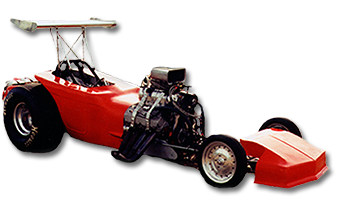
Our blown nitro altered (currently for sale or trade) will be on display at the NHRA Infineon Nationals, July 29-31, at Infineon Raceway at Sonoma, CA. This is the cover car (more…)

More on Air Scoop Size

Tuesday, June 7th, 2011

note: This is a continuation of a previous article on Air Scoop Size.

In the article in our freebies section entitled Air Scoop Size, an example of a 3,400 CFM blown engine was analyzed. The discussion of that value is continued to illustrate the very large amount of air used by a race engine to make power. (more…)

Drag Racecar For Sale or Trade — SOLD

Tuesday, May 17th, 2011

Blown Nostalgia Funnycar; also with 23T Altered body & wing; cover car featured thoughout our tech books; funny car very streamlined & very light; blown alc-nitro KB Hemi (more…)